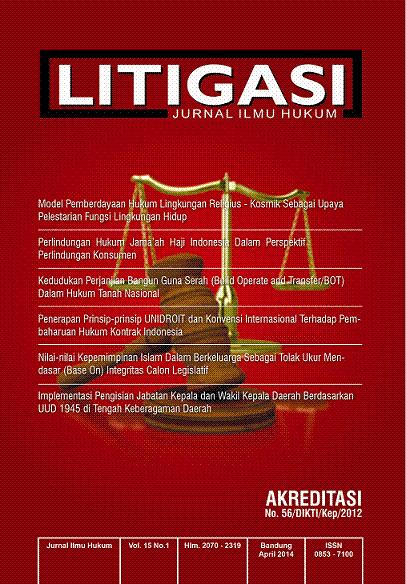
KEDUDUKAN PERJANJIAN BANGUN GUNA SERAH (BUILD OPERATE AND TRANSFER/BOT) DALAM HUKUM TANAH NASIONAL
DOI:
https://doi.org/10.23969/litigasi.v15i1.633Abstract
Indonesia is a state based on a rule of law the goal of which is to realize a just, prosperous, and materially and spiritually equal people. To realize the goal, progressively, sustainable national development has been conducted. The implementation of the development needs, besides from money, the availability of strategic land. To bridge the lack in both of them, BOT concept can be applied, as an agreement between the owner of land right and investor, where the former provides a feasibility study, building, and operation to the latter for a specified period of time, on the condition that when the BOT period of time has expired then the land together with the buildings and their appliances should be transferred to the former, so that both the owner of land right and the investors are mutually benefited.
Keywords : National Development; Land; Capital; BOT
ABSTRAK
Negara Indonesia merupakan negara hukum yang bertujuan untuk mewujudkan masyarakat adil dan makmur. Guna mewujudkan tujuan tersebut, dilakukan pembangunan nasional secara bertahap dan berkelanjutan. Pelaksanaan pembangunan tersebut selain perlu didukung oleh dana juga ketersediaan lahan strategis. Keterbatasan keduanya dapat dilakukan melalui konsep BOT, sebagai suatu perjanjian antara pemilik hak atas tanah dengan investor, dimana pemilik hak atas tanah menyerahkan studi kelayakan, pembangunan, pengoperasian kepada investor pada suatu jangka waktu tertentu, dengan ketentuan apabila masa BOT telah habis, tanah beserta bangunan, serta kelengkapan bangunan diserahkan kepada pemilik hak atas tanah, sehingga baik pemilik hak atas tanah maupun pihak investor yang mendanai pembangunan objek BOT memiliki keuntungan.
Kata Kunci : Pembangunan Nasional; Tanah; Dana; BOT
Downloads
Downloads
Submitted
Published
How to Cite
Issue
Section
License
Jurnal LITIGASI utilizes the Creative Commons Attribution 4.0 International License (CC-BY 4.0) to facilitate the broad dissemination and reuse of scholarly work. Authors retain copyright of their research while granting the journal the right of first publication. Under this license, others are permitted to share, copy, and adapt the material, provided that the original authorship and initial publication in this journal are properly cited.