
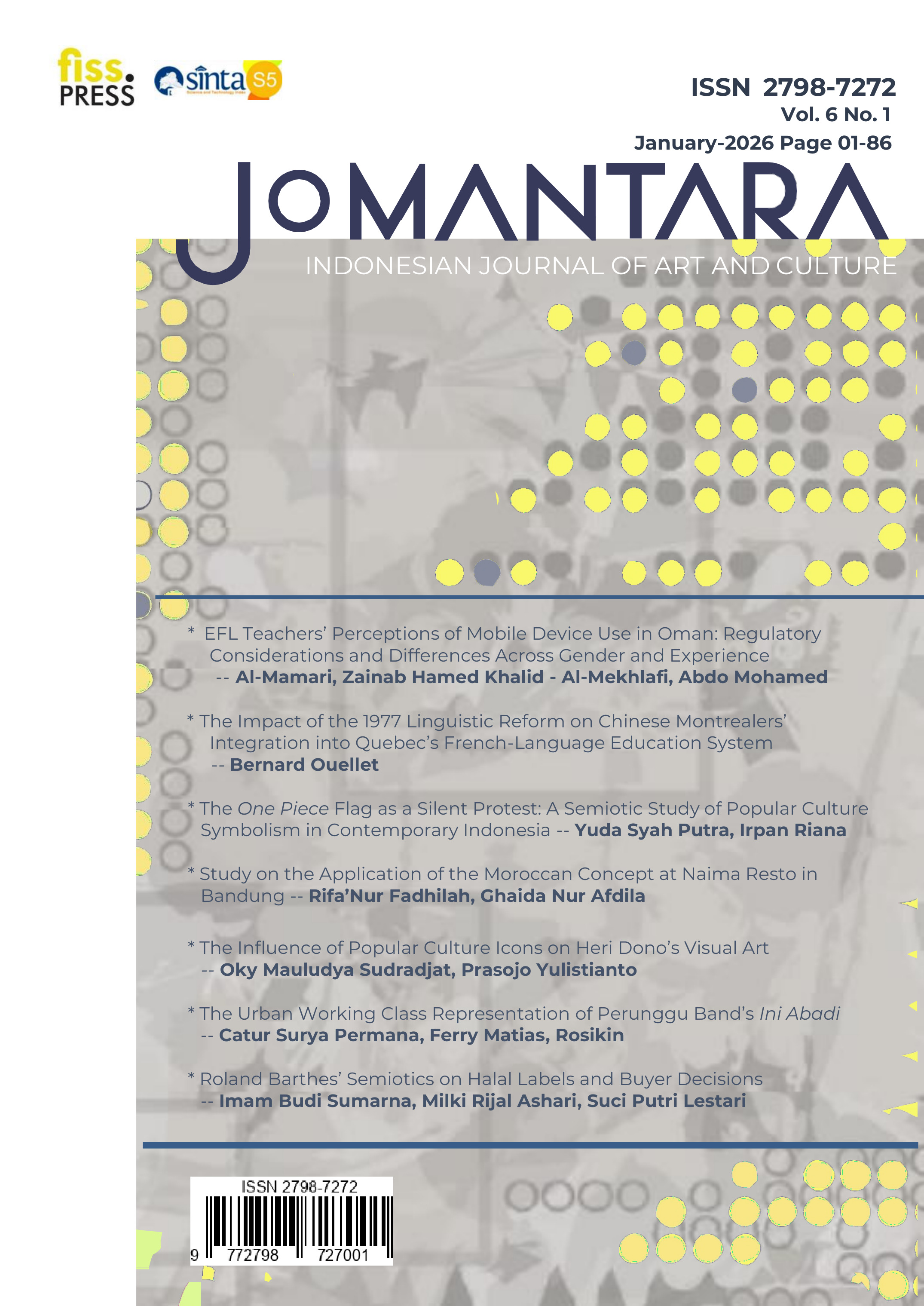
The Urban Working Class Representation of Perunggu Band’s Ini Abadi
DOI:
https://doi.org/10.23969/jijac.v6i01.27257Keywords:
Musical Composition, Lyrics, Perunggu, Sosio-Cultural, Urban Working ClassAbstract
This article analyzes the lyrics and musical composition of a song by the band Perunggu titled “
Ini Abadi”. Perunggu is known as a viral band that promotes ideas about the urban working class. The lyrics express the grievances of the working class in facing economic realities and the political alienation of power. The context of urban labor is tied to the oppression of time and mental effort, creating a polemic around social and cultural status. This band is recognized as “the office workers’ band,” reflecting a lifestyle that is commonly faced by band members in Indonesia, who juggle two professions: being musicians and holding primary jobs. In the music industry context, the creation and determination of lyrics and musical composition can hold significance regarding the urban societal context. The aim of this research is to dissect the lyrics and musical composition created by the band Perunggu, which represents the urban working class. The approach employs descriptive methods to analyze the song, utilizing theories of popular music analysis and cultural studies. The results indicate that this work represents the identity and anxieties of the urban working class through reflective lyrics and a composition that evokes a collective context of experience, resistance, and solidarity among the urban working class in Indonesia.
Downloads
References
Adorno, T. W., & Simpson, G. (1941). On popular music. Zeitschrift für Sozialforschung, 9(1), 17-48.
Anwar, S. (2020). GAYA HIDUP DAN PERILAKU KAUM URBAN PEKERJA KELAS MENENGAH JAKARTA DI ERA GLOBAL. PEKOBIS: Jurnal Pendidikan, Ekonomi dan Bisnis, 5(1).
Bailey, B. (2004). Book Review: Musical Identities. In: SAGE Publications Sage UK: London, England.
Ballantine, C. (1991). Concert and dance: The foundations of black jazz in South Africa between the twenties and the early forties. Popular Music, 10(2), 121-145.
Barbas, V. (2022). Cultural and musical identity as a formative factor of the new national composition schools from the end of the XIX century. Patrimoniul cultural: cercetare, valorificare, promovare, 1.
Bennett, A. (2001). Cultures of popular music: McGraw-Hill Education (UK).
Born, G. (2011). Music and the materialization of identities. Journal of Material Culture, 16(4), 376-388.
Chau, C.-j., & Horner, A. (2015). The effects of pitch and dynamics on the emotional characteristics of piano sounds. Paper presented at the ICMC.
Chau, C.-J., Mo, R., & Horner, A. (2016). The emotional characteristics of piano sounds with different pitch and dynamics. Journal of the Audio Engineering Society, 64(11), 918-932.
Cooper, G. W., Cooper, G., & Meyer, L. B. (1963). The rhythmic structure of music: University of Chicago press.
Cutler, C. (2000). “Chanter en yaourt”: Pop music and language choice in France. Popular music & society, 24(3), 117-133.
Davidson, J. W. (1997). The social in musical performance. The social psychology of music, 209-228.
Dean, L. (2023). Songs as Narratives: Ethical Tensions in Midnight Oil’s Dead Heart (1986) and Gadigal Land (2020). In Narrative Research Now (pp. 105-121): Bristol University Press.
Fedorak, S. A. (2018). What is popular culture? In The Routledge handbook of popular culture and tourism (pp. 9-18): Routledge.
Fijai, A. A., Pujiati, H., & Setiawan, I. (2022). Class struggle seen in Ernest Jones three selected poems:'The Song of The Poor','The Song The Lower Classes', and'A Song for People'. Jentera: Jurnal Kajian Sastra, 11(1), 41-67.
Fitryarini, I. (2023). Pembentukan Budaya Populer Dalam Kemasan Media Komunikasi Massa. Jurnal Ilmiah Komunikasi Makna, 2(2), 9-22.
Fox, A. A. (2004). Real country: Music and language in working-class culture: Duke University Press.
Frith, S. (2004). Popular Music: music and identity (Vol. 3): Psychology Press.
Haugh, W. A. (2007). Real Country: Music and Language in Working-Class Culture. Anthropological Quarterly, 80(4), 1209-1213.
Heryanto, A. (2012). Budaya Populer Di Indonesia Mencairnya Identitas Pasca Orde Baru (terj). Yogyakarta: Jalasutra Yogyakarta.
Hsu, D. Y., Huang, L., Nordgren, L. F., Rucker, D. D., & Galinsky, A. D. (2015). The music of power: perceptual and behavioral consequences of powerful music. Social Psychological and Personality Science, 6(1), 75-83.
Ida, R. (2014). Metode penelitian: Studi media dan kajian budaya: Kencana.
Kuduk, M. (2018). Bruce Springsteen: Voice of the Working Class.
Kаblovа, T., & Teteria, V. (2020). Popular Song Creativity in the Socio-cultural Context. Journal of History, Culture & Art Research/Tarih Kültür ve Sanat Arastirmalari Dergisi, 9(3).
MacDonald, R., & Saarikallio, S. (2022). Musical identities in action: Embodied, situated, and dynamic. Musicae Scientiae, 26(4), 729-745.
Machin, D. (2010). Analysing popular music: Image, sound and text: SAGE publications.
Machin, D., & Thornborrow, J. (2003). Branding and discourse: The case of Cosmopolitan. Discourse & Society, 14(4), 453-471.
Martin, D.-C. (2012). Auprès de ma blonde. Revue française de science politique, 62(1), 21-43.
Morgan, R. P. (1980). Musical time/musical space. Critical inquiry, 6(3), 527-538.
Põder, K., & Kiilu, K. (2015). The formation of musical identity. The European Journal of Social & Behavioural Sciences.
Preniqi, V., Kalimeri, K., & Saitis, C. (2022). " More Than Words": Linking Music Preferences and Moral Values Through Lyrics. arXiv preprint arXiv:2209.01169.
Raditya, M. H. (2016). Mengartikulasikan Relasi Musik dengan Radikalisme. Jurnal Studi Pemuda, 5(1), 386-403.
Richardson, J. E. (2017). Analysing newspapers: An approach from critical discourse analysis: Bloomsbury Publishing.
Rodger, G. M. (2020). Popular Song and Working-Class Culture. In The Oxford Handbook of Music and Intellectual Culture in the Nineteenth Century (pp. 409): Oxford University Press.
Sawyer, J. E., & Gampa, A. (2020). Work alienation and its gravediggers: Social class, class consciousness, and activism. Journal of Social and Political Psychology, 8(1), 198-219.
Schafer, R. M. (1993). The soundscape: Our sonic environment and the tuning of the world: Simon and Schuster.
Sholahudin, U. (2020). Membedah Teori Kritis Mazhab Frankfurt: Sejarah, Asumsi, Dan Kontribusinya Terhadap Perkembangan Teori Ilmu Sosial. Journal of Urban Sociology, 3(2), 71-89.
Spyrou, A. (2019). Liquid identity in music composition. The University of Iowa,
Storey, J. (2018). Cultural theory and popular culture: An introduction: Routledge.
Strinati, D. (2014). An introduction to studying popular culture: Routledge.
Tagg, P. (1994). Debate: From refrain to rave: the decline of figure and the rise of ground1. Popular Music, 13(2), 209-222.
Tagg, P., & Collins, K. E. (2001). The Sonic Aesthetics of the Industrial: Re-Constructing Yesterday's Soundscape for. Dartington College. Retrieved from http://www.tagg.org/articles/xpdfs/dartington2001.pdf
Treece, D. (2018). Bringing Brazil’s resistance songs to London:: words and music in translation. Veredas: Revista da Associação Internacional de Lusitanistas, 27, 68-84.
Van Leeuwen, T. (1999). Speech, music, sound.
Vieillard, S., Roy, M., & Peretz, I. (2012). Expressiveness in musical emotions. Psychological research, 76, 641-653.
Downloads
Published
Issue
Section
License
Copyright (c) 2026 Publisher Universitas Pasundan

This work is licensed under a Creative Commons Attribution-NonCommercial 4.0 International License.
Copyright Notice

This work is licensed under a Creative Commons Attribution 4.0 International License.