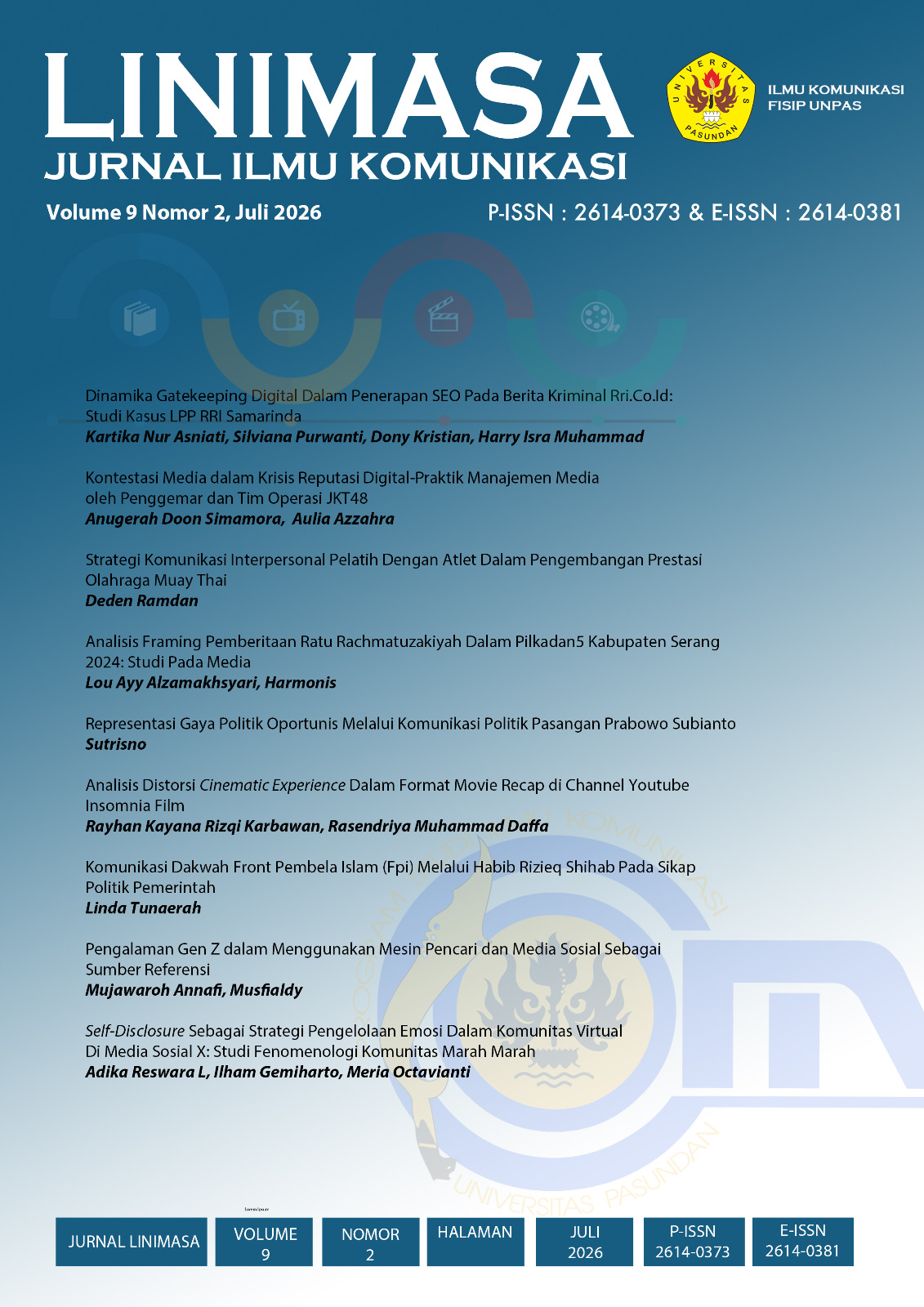
KONTESTASI MEDIA DALAM KRISIS REPUTASI DIGITAL: PRAKTIK MANAJEMEN MEDIA OLEH PENGGEMAR DAN TIM OPERASI JKT48
DOI:
https://doi.org/10.23969/linimasa.v9i2.51784Keywords:
digital reputation, fandom, media contestation, crisis communicationAbstract
This study examines media contestation in the digital reputation crisis of JKT48, focusing on media management practices carried out by fans and the JKT48 operational team. The development of digital media has shifted organizational reputation from a one-way communication process into a participatory arena where official messages, fan responses, online discussions, and media narratives interact with one another. This research uses an interpretive qualitative approach with a case study design. Data were collected through digital observation and documentation of social media conversations, official statements, online news, fan-generated content, and other digital traces related to the reputation issue. The data were analyzed thematically to identify patterns of narrative contestation and media management practices. The findings show that JKT48’s digital reputation crisis is shaped through two interconnected channels: formal communication by the management team and informal communication by fans. The management team attempts to maintain information stability, deliver clarification, and protect organizational image, while fans participate by defending, criticizing, disseminating information, and constructing counter-narratives. Viewed through Social-Mediated Crisis Communication, Situational Crisis Communication Theory, paracrisis, and participatory culture, the crisis cannot be understood as one-way organizational communication. Instead, JKT48’s digital reputation is formed through dynamic negotiation among official messages, fan conversations, media coverage, and public responses.
Downloads
References
Alima, Y. N., & Ramadhanty, S. F. (2022). Penggunaan media digital sebagai panggung konser musik Korea di masa pandemi COVID-19: Studi kasus konser online BTS. Komuniti: Jurnal Komunikasi Dan Teknologi Informasi, 14(2), 236–258.
Aula, P., & Heinonen, J. (2016). The reputable firm: How digitalization of communication is revolutionizing reputation management. Berlin: Springer.
Austin, L. L., & Jin, Y. (Eds.). (2022). Social media and crisis communication (2nd ed.). Abingdon: Routledge.
Ayundari, K. W., & Perbawani, P. S. (2021). Dinamika online persona akun anonim Twitter penggemar KPop. Jurnal Media Dan Komunikasi Indonesia, 2(1), 40– 54. https://doi.org/10.22146/jmki.63068
Azizah, U. N., & Meltareza, R. (2025). Manajemen Komunikasi Krisis JKT48 Operation Team Pasca Kasus No Encore pada Konser JKT48 Full House 2025. Konsensus : Jurnal Ilmu Pertahanan, Hukum Dan Ilmu Komunikasi, 2(6). https://doi.org/10.62383/konsensus.v2i 6.1413
Braun, V ., & Clarke, V . (2006). Using thematic analysis in psychology. Qualitative Research in Psychology, 3(2), 77–101. https://doi.org/10.1191/1478088706qp0 63oa
Brown, K. A., & Boman, C. D. (2022). Extending Experimental Crisis Communication Research. In The Handbook of Crisis Communication. John Wiley & Sons, Ltd. https://doi.org/10.1002/9781119678953 .ch2
Cahyani, I. P., Syaikhah, H., & Irawatie, A. (2022). Memahami pemaknaan self- disclosure melalui pengalaman para pengguna akun pseudonim di Twitter. Komuniti: Jurnal Komunikasi Dan Teknologi Informasi, 14(2), 146–164. https://doi.org/10.23917/komuniti.v14i 2.18012
Chang, H.-C. H., Pham, B., & Ferrara, E. (2023). Parasocial diffusion: K-pop
LINIMASA : JURNAL ILMU KOMUNIKASI E-ISSN :2614-0381, ISSN: 2614-0373 VOLUME: IX, NO. 2, JULI, 2026
fandoms help drive COVID-19 public health messaging on social media. Online Social Networks and Media, 37, 100267. https://doi.org/10.1016/j.osnem.2023.1 00267
Chen, F., & Holladay, S. J. (2023). Identifying and responding to social media risks: Towards an organizational paracrisis communication framework. Corporate Communications: An International Journal, 28(1), 103–117. https://doi.org/10.1108/CCIJ-11-2021- 0124
Cheng, Y., Wang, Y., & Kong, Y. (2022). The state of social-mediated crisis communication research through the lens of global scholars: An updated assessment. Public Relations Review, 48(2), 102172. https://doi.org/10.1016/j.pubrev.2022.1 02172/
Cheng, Y., & Cameron, G. T. (2022). Contingent Organization–Public Relationships and their Application in Organizational Crises. In The Handbook of Crisis Communication. John Wiley & Sons, Ltd. https://doi.org/10.1002/9781119678953 .ch8
Coombs, W. T. (2007). Protecting Organization Reputations During a Crisis: The Development and Application of Situational Crisis Communication Theory. Corporate Reputation Review, 10(3). https://doi.org/10.1057/palgrave.crr.155 0049
Coombs, W. T. (2022). Ongoing crisis communication: Planning, managing, and responding (6th ed.). New York: SAGE Publications.
Cornelissen, J. (2020). Corporate communication: A guide to theory and practice (6th ed.). New Y ork: SAGE
Publications.
Darussalam, A. Z., Sugiyanto, D. R., &
Lubis, D. P . (2021). Analisis krisis public relations pada peristiwa tumbangnya pohon di Kebun Raya Bogor. PRofesi Humas: Jurnal Ilmiah Ilmu Hubungan Masyarakat, 5(2), 251– 269. https://doi.org/10.24198/prh.v5i2.2943 9
Denzin, N. K., & Lincoln, Y. S. (Eds.). (2018). The SAGE handbook of qualitative research (5th ed.). New York: SAGE Publications.
Diddi, P., & Wei, L. (2022). Crisis management on social media: Effect of pre-crisis inoculation strategy and midst-crisis organizational interactivity. Public Relations Review, 48(5), 102206. https://doi.org/10.1016/j.pubrev.2022.1 02206
Driessen, S., Jones, B., & Litherland, B. (2024). From fan citizenship to fanspiracies: Politics and participatory cultures in times of crisis. Convergence: The International Journal of Research into New Media Technologies, 30(1), 1– 9. Retrieved from 10.1177/13548565241236005
Gu, M., Guo, H., Zhuang, J., Du, Y., & Qian, L. (2022). Social media user behavior and emotions during crisis events. International Journal of Environmental Research and Public Health, 19(9), 5197. https://doi.org/10.3390/ijerph19095197
Hearit, K. M. (2022). Corporate Apologia as Crisis Communication. In The Handbook of Crisis Communication. John Wiley & Sons, Ltd. https://doi.org/10.1002/9781119678953 .ch6
Huang, M., & Ki, E.-J. (2023). Protecting
LINIMASA : JURNAL ILMU KOMUNIKASI E-ISSN :2614-0381, ISSN: 2614-0373 VOLUME: IX, NO. 2, JULI, 2026
organizational reputation during a para- crisis: The effectiveness of conversational human voice on social media and the roles of construal level, social presence, and organizational listening. Public Relations Review, 49(5), 102389. https://doi.org/10.1016/j.pubrev.2023.1 02389
Jenkins, H., Ito, M., & Boyd, D. (2016).
Participatory culture in a networked era: A conversation on youth, learning, commerce, and politics. Cambridge: Polity Press.
Jin, Y., Liu, B. F., & Austin, L. L. (2014). Examining the Role of Social Media in Effective Crisis Management: The Effects of Crisis Origin, Information Form, and Source on Publics’ Crisis Responses. Communication Research. https://doi.org/10.1177/0093650211423 918
JKT48. [@officialJKT48]. (2025, July 16). Https://t.co/kAySZZaqtB [Tweet]. X. https://x.com/officialJKT48/status/1945 430205637783637
JKT48 Charts Updates. [@updatesjekeyti]. (2025, July 7). Fritz Fernandez stuns in new birthday photo [Tweet]. X. https://x.com/updatesjekeyti/status/194 2105656972181684
JKT48 Charts Updates. [@updatesjekeyti].
(2025a, July 11). JKT48 staff lying again. [Tweet]. X. https://x.com/updatesjekeyti/status/194 3891808569942143
JKT48 Charts Updates. [@updatesjekeyti]. (2025b, July 12). Marsha JKT48 was still 15 years old (minor) when she attended that birthday event [Tweet]. X. https://x.com/updatesjekeyti/status/194 3903758855156043
Kemp, S. (2024). Digital 2024: Indonesia. Retrieved from DataReportal website: https://datareportal.com/reports/digital-
2024-indonesia. Accessed 13 Mei 2026 Moleong, L. J. (2017). Metodologi penelitian kualitatif (Edisi revisi). Bandung: PT
Remaja Rosdakarya.
Mulyana, D. A., Qonitah, A., & Salsabila, S.
A. (2024). Bentuk budaya partisipasi: Studi deskriptif kualitatif pada fandom bobotoh. Comdent: Communication Student Journal, 2(1). https://doi.org/10.24198/comdent.v2i1. 51939
Muthmainnah, S., Dewi, E. A. S., & Adiputra, A. V . (2023). Dinamika komunikasi kelompok fandom ARMY Indonesia dalam melakukan aktivisme digital. Comdent: Communication Student Journal, 1(2), 389–405. https://doi.org/10.24198/comdent.v1i2. 50572
Perbawani, P. S., & Nuralin, A. J. (2021). Hubungan parasosial dan perilaku loyalitas fans dalam fandom KPop di Indonesia. LONTAR: Jurnal Ilmu Komunikasi, 9(1), 42–54. https://doi.org/10.30656/lontar.v9i1.30 56
Pfeffer. (n.d.). Power: Why Some People Have It — and Others Don’t. Stanford Graduate School of Business. Retrieved April 15, 2026, from https://www.gsb.stanford.edu/faculty- research/books/power-why-some- people-have-it-others-dont
Salsabila, Z. (2024). Fenomena fanwar dalam fanatisme penggemar KPop pada media sosial Twitter. Interaksi: Jurnal Ilmu Komunikasi, 13(1), 18–36.
Seeger, H. S. (2022). A Meta-Theoretical Orientation to Crisis Communication. In The Handbook of Crisis Communication. John Wiley & Sons, Ltd. https://doi.org/10.1002/9781119678953
LINIMASA : JURNAL ILMU KOMUNIKASI E-ISSN :2614-0381, ISSN: 2614-0373 VOLUME: IX, NO. 2, JULI, 2026
.ch5
Sumardiono, N. (2022a). Aktivisme digital dalam konteks penggalangan donasi fandom BTS (ARMY) Indonesia melalui Twitter. Jurnal Komunikasi, 16(2), 113–128. https://doi.org/10.20885/komunikasi.vo l16.iss2.art2
Sumardiono, N. (2022b). Komodifikasi fandom: Studi pada penggunaan media digital fandom boyband BTS di Indonesia. Komuniti: Jurnal Komunikasi Dan Teknologi Informasi, 14(1), 44–68. https://doi.org/10.23917/komuniti.v14i 1.16602
The Handbook of Crisis Communication. John Wiley & Sons, Ltd. https://doi.org/10.1002/9781119678953 .ch4
Van
der Meer, T. G. L. A., & Kroon, A. c. (2022). Crisis Communication and Computational Methods. In The Handbook of Crisis Communication. John Wiley & Sons, Ltd. https://doi.org/10.1002/9781119678953 .ch1
Vignal Lambret C., Barki E. Social media crisis management: Aligning corporate response strategies with stakeholders’ emotions online. J Contingencies and Crisis Management. 2018;26:295–305. https://doi.org/10.1111/1468- 5973.12198
Vogler, D., & Meissner, F. (2022). Tackling the Information Overload.
Yang, T., Zhu, G., & Wu, F. (2024). Participate in philanthropy for idols or society? Fans’ social media practices, dual identity, and civic engagement in Chinese online fandom. Social Media + Society, 10(2).
Yin, R. K. (2018). Case study research and applications: Design and methods (6th ed.). New York: SAGE Publications. Yuanita, D. (2021). Peran key opinion leader dalam strategi public relations pada komunikasi krisis perusahaan. PRofesi Humas: Jurnal Ilmiah Ilmu Hubungan Masyarakat, 6(1), 23–44.